How table bookings really work in Bali
Minimum spend, deposit, guestlist, walk-in: four words that mean four different things, and getting them mixed up is how people end up standing at the door of a beach club at sunset.
Updated August 19, 2026 · 4 min read

Most confusion about going out in Bali comes from one thing: "booking a table" means something different at a restaurant, at a beach club and at a nightclub. Here is how each one actually works, so you know what you are agreeing to before you agree to it.
Three different things
A restaurant reservation is what you already know. You book a time, you sit down, you order, you pay for what you ate. Most restaurants on the island work exactly this way — no minimum, no deposit.
A table at a beach club or a nightclub is a different product. You are reserving a physical space — a daybed, a cabana, a booth by the dancefloor — for the night, and the venue attaches a minimum spend to it. Sunset-facing spots are the scarce ones; they go days ahead in high season and hours ahead the rest of the year.
A guestlist is not a table at all. It is your name at the door for a specific event, usually free, usually capacity-limited, often with a time window ("before 11pm"). You get in, then you stand where everyone else stands.
What "minimum spend" actually means
It is not an entry fee and it is not a charge on top. It is a floor on what you spend inside: order food and drinks up to that amount and you have met it. Spend more, you pay the difference; spend less, you pay the minimum anyway.
Two things surprise people. The minimum belongs to the table, not to the person — the same booth costs the same whether you are four or eight, which is why a bigger group usually makes the maths kinder. And the number moves: by venue, by night of the week, by season, and by which table you are on. Nobody can quote you a real figure without asking the venue for that specific date, which is why we do not publish one. The concierge comes back with the confirmed amount before you commit.
The deposit
Clubs and beach clubs generally ask for a deposit to hold a table on a busy night. It is not an extra cost — it is deducted from what you spend on the night. It exists because no-shows on a Saturday cost the venue a table it could have sold three times over.
What varies is the cancellation window, and it is the one thing worth asking about up front. Some venues release a table free of charge up to a day before; others keep the deposit inside twenty-four hours. Ask before you pay, not after you cancel.
Timing, honestly
- Sunset tables are the most contested thing on the island. For a Friday or Saturday in July or August, days ahead. Off-season, the same afternoon can work.
- Club tables fill late and unevenly — the good ones go once the line-up is announced, not the week before.
- Arrival matters. A table held for 19:00 is usually held for about half an hour, no longer. If you are running late, say so; a message keeps the table, silence loses it.
- Full moon, public holidays and the last week of December behave like nothing else. Treat them as their own season.
Group size and seating
Booking online for eight people through a widget is how groups end up split across three tables. Any group above four should be booked by a person who confirms the seating, not just the reservation. If you are a group of ten or more, say so in the first message — some venues need a different kind of table, and some cannot take you at all after a certain hour.
Dress and the door
Beach clubs are relaxed by day and less so after dark. Clubs turn people away for beachwear, singlets and flip-flops, and the bigger the night, the stricter the door. If you have a table, arrive as a group and give the name on the booking rather than joining the general queue.
What to send when you ask
The fastest bookings come from four lines: the date, how many of you, what kind of evening (dinner, sunset, dancing, birthday) and any constraint (a flight landing at 20:00, someone who does not drink, a wheelchair). Everything else is our job.


Atlas Beach Club
Beach clubs · Berawa
Atlas Beach Club sits on Berawa Beach and bills itself as the biggest beach club in the world. Its signature beanbags sit right on the sand facing the sea, beside a vast pool and a pool bar where DJs play through the day. Daybeds and sofas are spread across distinct zones, from The Deck restaurant overlooking the beach to the Party Side in front of the stage. Daily shows draw on the four elements, and a beachfront padel court and a 100-metre flying fox complete the site.

Savaya Bali
Clubs · Uluwatu
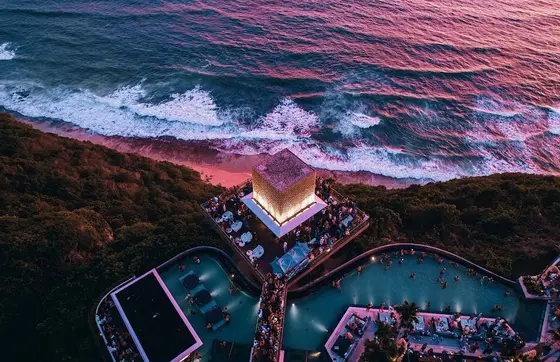
Savaya is a clifftop club in Pecatu, Uluwatu, set 100 metres above the Indian Ocean between jungle and limestone cliffs, with pools and The Cube, the landmark that frames its horizon. Named the number-one club in Asia three years running (2024–2026) and fifth in the world in 2026 in DJ Mag's Top 100 Clubs, it is open daily: Last Light every Monday, weekday nights, and international headliners at weekends. Strictly 21+, smart casual.


Finns Beach Club
Beach clubs · Berawa
FINNS Beach Club stretches along the beachfront at Berawa, in Canggu, under a bamboo structure designed by PBM Architecture. It is adults-only and divided into several party zones, from FINNS Beach Party and FINNS Garden Party to FINNS Grey Goose Party and FINNS VIP Party, with pools, swim-up bars, private cabanas, dance floors and restaurants spread across the site. Resident DJs and live singers keep an all-day party going every day, and the club also hosts private events, birthdays and corporate groups.

El Kabron
Beach clubs · Uluwatu
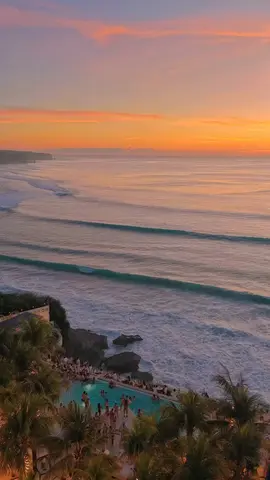
El Kabron stands on the limestone cliffs of Pecatu in Uluwatu, above the Indian Ocean, and has been open since 2011. It has three parts: the Hedonism Lounge, an adults-only infinity-pool area with daybeds and sofas; the Sunset Theater at the cliff edge, set up for sunset dinners; and a Mediterranean restaurant serving seafood, oysters, paella and steak. Its sunset parties bring DJs with live saxophone, violin and trumpet, with the White Sunset Party, the Afro House Sunset Party and pool parties among the weekly regulars.
Changing or cancelling
Tell us as early as you can. A table released two days out is a table someone else takes; a table released at 20:00 on Saturday is a table nobody takes, and that is where cancellation terms bite. Changing the headcount is usually easy, changing the date is usually a new booking.
The short version
Restaurants: just book. Beach clubs and clubs: reserve a space with a minimum, often with a deposit, and expect the amount to depend on the night. Guestlists: free, limited, time-bound. When in doubt, ask the concierge and get the answer for your exact date — or start from the venues.
Questions we get asked
+What is a minimum spend at a Bali beach club?
A floor on what you spend inside, not an entry fee. Food and drinks count towards it. It belongs to the table rather than to each guest, so a larger group reaches it more comfortably. The amount depends on the venue, the table, the night and the season — the concierge confirms it with the venue for your date.
+Is the deposit an extra cost?
No. It secures the table and is deducted from what you spend on the night. What differs between venues is the cancellation window — ask before paying it.
+How far ahead should I book a sunset table?
In July, August and around New Year, several days for a Friday or Saturday. Outside those periods the same afternoon is often enough, except on full moon nights and public holidays.
+Do I need a table to get into a club in Bali?
No. A free guestlist gets your name at the door for a given event, with limited places and often a time limit. A table buys you a reserved space for the night, with a minimum spend attached.
Want us to arrange it?
Tell the concierge what you have in mind — a table, a guestlist, a villa, a driver. We answer within 15 minutes, 24/7.
Ask the concierge